
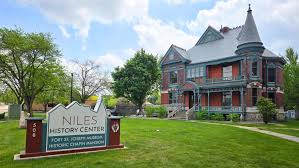
If you stroll through downtown Niles, Michigan, you might pass by a striking red-brick mansion with ornate details and wonder about its story. That landmark is the Chapin Mansion — a building that tells the tale of entrepreneurial spirit, architectural beauty, civic dedication, and community pride.
A Gilded Beginning
Built in the early 1880s, the Chapin Mansion was the private home of Henry A. Chapin and his wife, Ruby. Chapin was a successful businessman who first made his mark in general merchandising in Niles before investing in Michigan’s Upper Peninsula iron lands. When a rich iron ore deposit was discovered on that land in 1878, Chapin’s fortune grew significantly from royalties. He used that wealth to commission one of the most elaborate homes in the region — designed by Chicago architects Wheelock & Clay and completed in 1884.
The home is a standout example of Queen Anne architecture, notable for its complex roofline, turreted corners, decorative terra cotta trim, and artistic interior features such as stained glass windows and ornate woodwork that give a window into the aesthetic sensibilities of the late Victorian era.
From Private Home to Civic Heart
Following Chapin’s death in 1898 and Ruby’s passing in 1902, the mansion stayed in the family until the early 1930s. In 1932–33, Chapin’s grandchildren sold the property to the City of Niles with a special stipulation: it had to be used for civic purposes. True to the family’s vision, the mansion became Niles City Hall, serving in that role for nearly 80 years — right through 2012.
This was more than repurposing a building; it was embedding history in the daily life of the community. For generations, local government meetings, decisions, and public events were tied to this stately symbol of civic identity.
A Museum of Community and Culture
In 2013, the mansion’s steward- ship shifted to the Niles History Center, and the mansion reopened its doors to the public as a living history museum. Since then, extensive rehabilitation — involving over $1.5 million and contributions from state, local, and private sources — has restored many of the mansion’s historical features while adapting it for programs, tours, and community events.
Today, the mansion hosts annual events, school field trips, adult tours, and public programming that connect visitors to the rich regional past. Its walls contain stories of Victorian life, enterprise, municipal growth, and the evolution of Niles itself.
More Than a House — A Symbol of Niles’ Legacy
The Chapin Mansion is more than just a beautiful old house downtown. It’s a gateway to Niles’ history — a testament to the people who shaped this community, from early settlers and traders to civic leaders and preservation champions. It stands alongside other local treasures, like the Fort St. Joseph Museum and the archaeological sites along the St. Joseph River, which together chronicle centuries of cultural exchange and community growth.
When you enter the Chapin Mansion — with its carved woodwork, nine fireplaces, stained glass, and thoughtful preservation — you’re stepping into a story that belongs to all of Niles. It’s a reminder that history isn’t just in textbooks or distant places; it lives in familiar corners of our own hometowns, waiting to be discovered and celebrated.
Check out this article next